What Is an Outdoor DIP LED Display?
An outdoor DIP LED display uses separate red, green, and blue LED lamps to form each pixel. Its direct-emitting design can provide strong brightness, helping content remain visible in daylight and across open spaces. A DIP LED display outdoor installation may suit stadiums, roadside signs, plazas, and large building façades. The right choice depends on viewing distance, pixel pitch, ambient light, and the level of detail viewers need. Bigger pixels can work well from far away. Up close, they may look coarse.
Weather protection matters just as much as brightness. Buyers should check the cabinet’s stated ingress protection, sealing, ventilation, and access for maintenance. Heat, dust, rain, and long operating hours all affect reliability. Ask how modules are replaced and whether spare parts will remain available. These practical details are easy to overlook. They can shape the total cost over time.
This guide explains how DIP technology works, where it performs well, and what to compare before choosing a display. It also considers trade-offs against other LED types, including viewing angle, color consistency, and image detail. DIP can be a practical option for some large outdoor screens, but it is not automatically the best fit. Site conditions matter. A careful assessment of sunlight, audience position, installation structure, and maintenance access makes the decision more dependable.
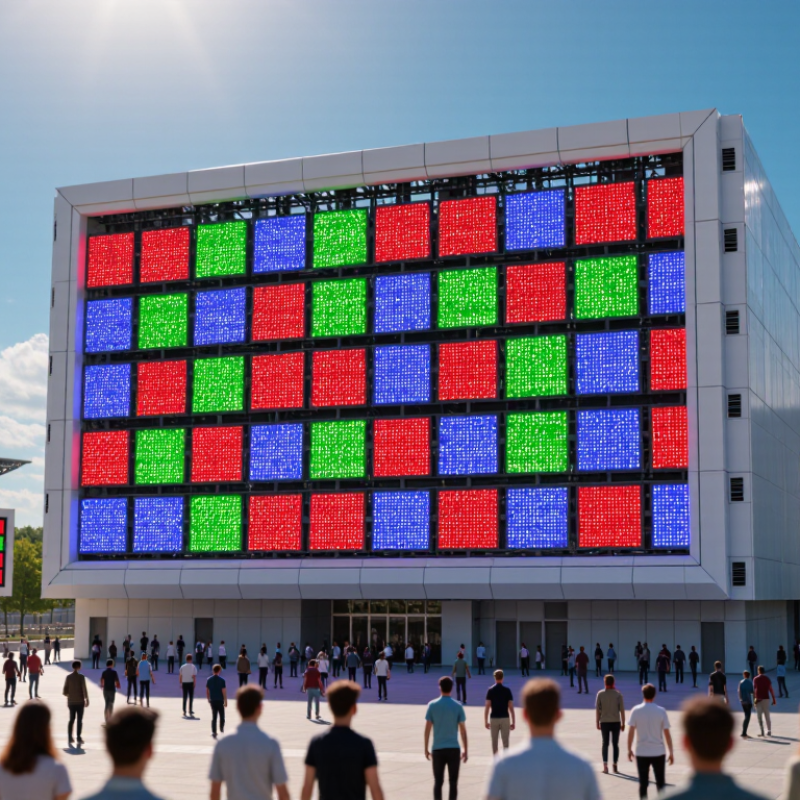
Core Definition of an Outdoor DIP LED Display
What Is an Outdoor DIP LED Display?
Core Definition of an Outdoor DIP LED Display
An outdoor DIP LED display is a large-format screen made from pixels using dual in-line package (DIP) LEDs. In each pixel, red, green, and blue LED elements are typically mounted as separate, pin-through components on a circuit board. Their combined light creates colors and images.
A simple principle.
The package design matters outdoors. Individual LEDs protrude from the module, and their lenses direct light toward viewers. This construction can provide strong brightness in daylight, while lens shape and viewing angle affect how clearly content appears from the side. Modular panels form the screen, while protective treatments and sealed cabinets help limit exposure to rain, dust, and temperature changes.
They are not magic.
DIP describes the LED package, not a complete performance rating. Outdoor suitability also depends on pixel pitch, refresh behavior, cabinet protection, heat management, and installation. A roadside screen needs legible text at a distance; a venue display may need finer detail for nearby viewers. I would not treat “outdoor” as a guarantee of equal weather resistance. Check the stated protection rating and operating limits against the site conditions. Maintenance access matters, too.
How DIP LED Pixels Produce Images
What Is an Outdoor DIP LED Display?
How DIP LED Pixels Produce Images
Outdoor DIP LED pixels create images by combining red, green, and blue light. In a common design, three LED elements sit in separate, lens-covered packages. From a normal viewing distance, their light blends into one pixel. Light becomes color. A controller sends image data to driver circuits, which adjust each color channel. Mixing red and green can produce yellow; balancing all three channels can produce white. This is additive color, not pigment mixing.
Across the panel, thousands of pixels follow the same image signal. The display refreshes rows rapidly, while pulse-width control helps vary brightness. Strong output and shaped lenses help the image stay visible in daylight. Up close, however, the grid remains visible. Pixel spacing matters: wider gaps can make small lettering look rough, even when the display is bright. That detail is easy to underestimate. Viewing distance and camera settings also affect the result; a phone video may show flickering bands that people do not notice in person. The basic RGB explanation is useful, but it leaves out calibration and differences between individual LEDs.
Main Components and Display Construction
An outdoor DIP LED display is built from separate red, green, and blue through-hole lamps mounted on a printed circuit board. Each group forms one pixel. The board carries driver components and connectors, while a front mask spaces the lamps and reduces glare. At a 10 mm pixel pitch, the layout works out to about 10,000 pixels per square metre, before cabinet borders and service gaps. Small parts matter.
Modules attach to a metal cabinet that supports the boards and helps transfer heat away from the LEDs. A power supply and receiving electronics distribute power and image data across the display. Gaskets, sealed cable entries, and a protective front face help shield these parts from rain and dust. IEC 60529 defines IP6X as dust-tight and IPX5 as protection against water jets; an IP65 rating combines both classifications. The U.S. Department of Energy’s 2022 Solid-State Lighting R&D Opportunities report identifies thermal management and reliability as continuing engineering challenges for LED systems. In real installations, heat can still collect around tightly packed components, and a poorly seated gasket can undermine an otherwise solid enclosure. That detail is easy to miss.
Performance Features for Outdoor Environments
An outdoor DIP LED display uses individual red, green, and blue LEDs to form images on a large screen. Its widely spaced, visible light points can remain clear in bright daylight, especially on roadside signs and stadium screens. Strong brightness helps, but it is not the whole story. Direct sun, viewing distance, and screen angle also affect readability.
Outdoor performance depends on more than the LEDs themselves. A sealed cabinet helps protect internal components from rain and dust, while suitable drainage and ventilation reduce moisture and heat buildup. Check the product’s stated ingress protection rating and operating temperature range for the intended location. Heat matters. Poor airflow can shorten component life, even when the display looks rugged from the outside.
DIP displays are often chosen for their brightness and robust individual LED packages, but their pixel spacing may look coarse at close range. That trade-off deserves attention. A display viewed from across a road has different needs from one beside a pedestrian path. Regular inspection can also catch loose connections, blocked vents, or uneven brightness before they become larger problems. In practice, installation details can matter as much as the screen specification.
What Is an Outdoor DIP LED Display? - Performance Features for Outdoor Environments | Performance Feature | Typical Characteristics | Outdoor Benefit |
| DIP LED construction | Uses individual red, green, and blue LED packages mounted through holes in a circuit board. DIP stands for dual in-line package. | The separated LED packages are suited to large-format displays designed for bright, exposed environments. |
| Brightness | Many outdoor models are specified around 5,000–10,000 nits; the actual level depends on the display design and configuration. | High brightness helps maintain visibility in daylight and direct sunlight. Automatic brightness control can reduce output in darker conditions. |
| Pixel pitch | Common outdoor configurations often use pitches of approximately 10–20 mm, though smaller and larger pitches are available. | A suitable pitch balances image detail with viewing distance, screen size, and installation cost. |
| Viewing angle | Typical specifications may be around 110–120° horizontally and 50–60° vertically, with variation by LED and module design. | A wider viewing area helps audiences see content from different positions; the effective angle depends on viewing conditions and installation. |
| Weather protection | Outdoor cabinets commonly use sealed construction. Some designs are rated IP65 on the front, while rear protection varies by cabinet and installation. | Appropriate ingress protection helps guard against dust and water. Check the specified rating for each side of the finished display. |
| Operating temperature | Specified operating ranges vary; outdoor systems are often designed for temperatures in the approximate range of −20°C to +60°C. | Suitable cabinet design, ventilation, and thermal management help the display operate across changing outdoor temperatures. |
| Refresh rate | Some configurations offer refresh rates of 1,920 Hz or higher. The achievable rate depends on the control system, driver, and settings. | A high refresh rate can help reduce visible flicker and improve camera capture, subject to the complete display configuration. |
| Color and grayscale | Full-color RGB output and grayscale processing are standard capabilities; bit depth and color performance vary by system. | These capabilities support gradients, smoother tonal transitions, and colorful content when properly calibrated. |
| Power and heat | Power consumption depends on screen size, brightness, content, and configuration. Maximum and average consumption are different measures. | Efficient power design and heat management can support reliable operation; compare both power figures for a specific display. |
| Maintenance | Service access may be provided from the front or rear, depending on the cabinet design and installation. | Choosing an appropriate service-access method can simplify inspection and component replacement at the installation site. |
Specifications are typical examples, not universal guarantees. Confirm the rated performance, environmental limits, and installation requirements for the complete display system.
Common Applications and Selection Factors
What Is an Outdoor DIP LED Display?
Outdoor DIP LED displays use separate red, green, and blue LEDs mounted through circuit boards. Their bright output and sturdy construction suit long-distance viewing in sunlit areas. Common applications include roadside signs, stadium scoreboards, transport hubs, and large venue displays. At roadside sites, clear text may matter more than fine detail. Match pixel pitch to the audience’s viewing distance.
Choose a pitch based on the nearest viewer, not just screen size. Check brightness for direct sunlight, and make sure it can be adjusted after dusk. Review weather protection, drainage, wind loading, and temperature limits for the actual site. Ask how technicians access modules and replace parts. Consider power use, camera-friendly refresh performance, and viewing angles. A specification sheet cannot capture every site condition. A field test is worth planning; assumptions can be wrong.
Tips: View a sample panel outdoors from the intended distance. Check text at noon and after sunset. Keep maintenance access clear.
What Is an Outdoor DIP LED Display? Common Applications and Selection Factors
Outdoor DIP LED displays use discrete red, green, and blue LEDs mounted through a circuit board. They are commonly used for roadside billboards, stadium perimeter screens, building façades, and outdoor information signs.
Selection guide: This chart uses the common planning rule of thumb that a 1 mm pixel pitch corresponds to about 1 m of minimum viewing distance. It is an estimate, not a guaranteed specification. Choose pitch based on audience distance and content detail; also check required brightness for sunlight, weather protection, and installation conditions.