
Choosing the right thrust washer can prevent costly wear, noisy operation, and unexpected downtime. Buyers often compare types by price alone, but that approach can fail under real working conditions. Load direction, rotation speed, temperature, lubrication, shaft hardness, and available space all influence performance.
Common options include plain thrust washers, flanged washers, spherical washers, and composite designs with PTFE or bronze layers. Plain metal washers suit simple, low-speed assemblies. Composite types can reduce friction where regular lubrication is difficult. Hardened steel versions may handle repeated axial loads, while bronze washers often perform well in applications requiring durability and heat resistance. Each design has limits.
The best choice depends on the machine, not the catalog label. A washer inside a gearbox may face oil exposure, shock loads, and continuous rotation. Another used in a hinge may experience slower movement but higher contamination. Buyers should check dimensions carefully, including inner diameter, outer diameter, thickness, flatness, and surface finish. Material certificates, inspection records, and consistent batch quality also matter. Reliable suppliers should explain test methods and operating limits clearly.
There is no universal winner.
A practical selection process should balance service life, maintenance needs, replacement access, and total cost. It is also wise to confirm the washer against the mating surface and lubricant before ordering large quantities. Small mismatches can create serious wear. Even experienced engineers sometimes overlook installation conditions. That is why this guide compares the top thrust washer types, their practical strengths, common weaknesses, and the applications where each option makes sense.
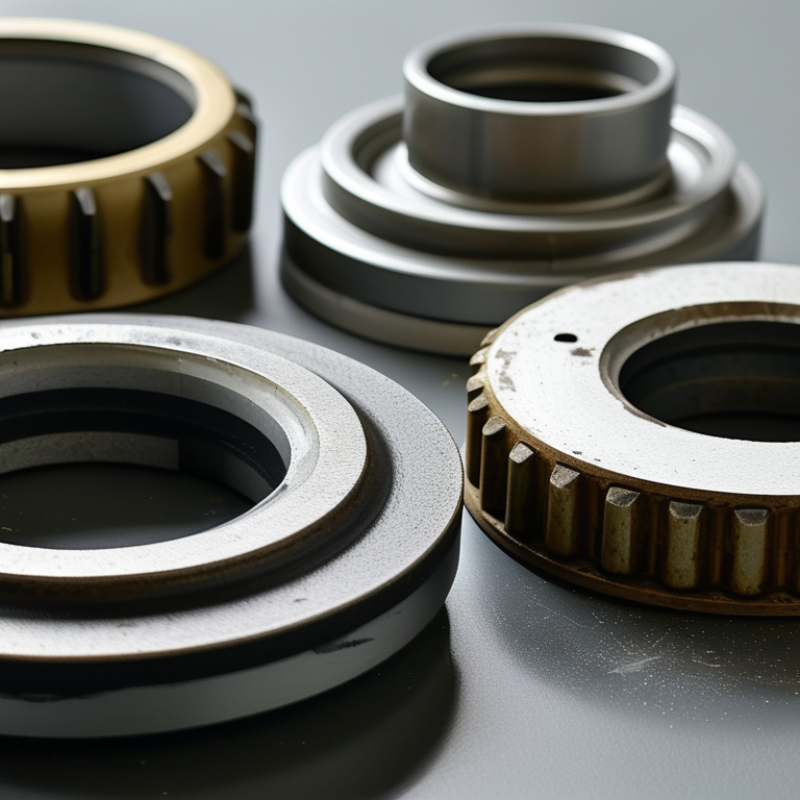
A thrust washer controls axial movement between rotating or stationary components. It absorbs pushing forces along a shaft instead of allowing metal surfaces to rub directly. In pumps, gearboxes, motors, and compact machinery, this small part can protect expensive components.
Its structure is simple but not casual. A plain washer usually has a flat ring, a defined inner diameter, and a controlled outer diameter. Grooved versions create channels for lubricant and help remove heat. Spherical washers can handle slight alignment errors, while flanged designs add guidance around a shaft. Common materials include hardened steel, bronze, sintered metal, and engineered polymers.
Material choice matters.
During operation, the rotating shaft or collar presses against the washer’s working face. Lubrication forms a thin film, reducing friction, wear, and temperature. At low speeds or high loads, boundary contact may still occur. This is where surface hardness, finish, clearance, and load rating become critical. A washer that fits loosely may shift, while excessive tightness can restrict movement and raise heat.
In practical selection, measure the shaft diameter, housing space, axial load, speed, and lubricant conditions. Check whether the load is continuous or intermittent. Buyers sometimes focus only on outside diameter. That shortcut can fail. Real assemblies are less tidy, and misalignment or contamination may change performance. Test results from the actual application remain more reliable than a catalog rating alone.
Metal thrust washers must match load, speed, lubrication, and shaft hardness. Hardened steel washers suit high static loads and shock loading. Their rigid surfaces resist deformation, but they need reliable lubrication. Otherwise, heat and scoring can develop quickly.
Bronze washers work well at moderate speeds and intermittent loads. They can embed small particles, which helps protect the shaft. Sintered bronze adds oil retention for start-stop movement. Bimetal washers combine a steel backing with a copper-based sliding layer. This structure supports higher loads while limiting friction. Stainless steel is useful in wet or corrosive areas, although it may wear faster without surface treatment.
Consider a practical sizing check. A 2,000-newton load on a 40–60 mm washer produces about 1.27 MPa average pressure. At 1,800 rpm, the mean sliding speed reaches roughly 4.7 m/s. That combination may exceed a plain bronze washer’s safe operating range. I would not trust a catalog PV value alone. Misalignment changes the real contact area.
ASTM G77 wear-test reports compare materials under controlled load, speed, and lubrication. ISO 281 also uses a 90% reliability basis for basic rating life, although thrust washers require separate wear evaluation. Buyers should request test conditions, lubricant type, temperature, and wear depth. Missing details weaken the comparison. Performance data needs context.
Polymer and composite thrust washers suit applications where low friction, quiet operation, and limited lubrication matter.
Common polymer options include PTFE-based materials, nylon, PEEK, and fiber-reinforced compounds. Each behaves differently under heat, pressure, and moisture.
PTFE offers very low friction, but it can creep under continuous heavy loads.
PEEK usually handles higher temperatures and stronger mechanical demands.
Nylon costs less, yet moisture can change its dimensions.
Composite thrust washers often combine a metal backing with a polymer or fiber-based sliding layer. This structure improves stiffness while maintaining a smooth contact surface.
In a compact actuator, for example, a composite washer can reduce start-up drag around a rotating pin. It may also tolerate brief dry-running periods.
Brief does not mean unlimited.
Buyers should compare load, speed, temperature, shaft hardness, and available lubrication.
The pressure-velocity value matters, but it should not replace application testing. A rough shaft can quickly damage even a well-selected washer. Misalignment creates uneven wear near one edge.
That detail is easy to miss. Check the washer after a realistic duty cycle, including starts, stops, heat, and contamination.
Dimensional stability also deserves attention when the assembly operates outdoors or near water. Selection charts help, but actual fit and operating conditions remain more reliable than a single catalog rating.
When selecting thrust washers, match the material to the working environment, not only the load rating. Hardened steel suits high loads and rigid assemblies, especially where shock loads occur. However, it needs reliable lubrication and corrosion protection. Bronze alloys work well in rotating joints with moderate speeds and marginal lubrication. They can tolerate small amounts of dirt better than many steel surfaces.
For wet or chemically exposed equipment, stainless steel offers useful corrosion resistance, but it is not automatically the best choice. Its galling risk may increase under pressure and poor lubrication. Polymer composite washers can reduce noise and operate without continuous oil supply. Temperature limits must be checked carefully. A washer near a hot pump casing may need a reinforced polymer or metal-backed design instead.
Supply conditions also matter. The U.S. Geological Survey’s Mineral Commodity Summaries 2024 reported global copper mine production at about 22 million metric tons in 2023. The same report placed zinc mine production near 12 million metric tons. These figures indicate broad material availability, but they do not prove suitability. ASTM and ISO material standards should verify hardness, composition, and dimensional performance. In practice, inspect the shaft surface, measure actual temperature, and review contamination risks before ordering. Engineers sometimes overvalue static load capacity. That mistake is common. A washer that survives a laboratory load can still fail quickly when dust, heat, and misalignment appear together.
Material selection guide based on load, speed, temperature, lubrication, contamination, and corrosion conditions
| Thrust Washer Type | Typical Material | Suitable Working Environment | Key Advantages | Main Limitations | Common Applications | Buyer Selection Priority |
|---|---|---|---|---|---|---|
| Metal Thrust Washer | Hardened steel, stainless steel, bronze, or brass | High static loads, moderate sliding speeds, and applications where dimensional rigidity is important | High compressive strength, good dimensional stability, and resistance to deformation | May require continuous lubrication; metal-on-metal contact can increase friction, noise, and wear | Gearboxes, agricultural equipment, pumps, industrial machinery, and heavy-duty pivots | Load capacity, hardness, surface finish, corrosion resistance, and lubrication method |
| Bronze Thrust Washer | Sintered bronze or cast bronze | Moderate-to-high loads with oil or grease lubrication; suitable for applications requiring good sliding compatibility | Good wear resistance, good thermal conductivity, and lower risk of seizure against steel surfaces | Heavier and generally more expensive than basic steel; porous grades may need correct oil impregnation | Electric motors, pumps, compressors, gear assemblies, and rotating shafts | PV performance, lubrication compatibility, shaft hardness, and heat dissipation |
| Sintered Oil-Impregnated Washer | Porous sintered bronze or iron with retained lubricant | Moderate-speed mechanisms where maintenance access is limited and intermittent lubrication is acceptable | Self-lubricating tendency, reduced maintenance, and consistent operation in relatively clean conditions | Performance depends on temperature, load, speed, and lubricant retention; unsuitable for severe contamination | Small motors, office equipment, fans, actuators, and light industrial mechanisms | Operating temperature, PV value, lubricant type, and service interval |
| PTFE-Based Composite Washer | PTFE layer supported by a metal backing and porous intermediate layer | Low-friction applications, limited lubrication, clean environments, and moderate temperatures | Very low friction, good anti-stick behavior, and reliable operation with little or no added lubricant | Limited load capacity compared with bulk metal; PTFE can creep under sustained high load or excessive heat | Automotive linkages, hydraulic equipment, linear mechanisms, and compact actuators | Friction coefficient, allowable PV value, temperature, mating surface, and chemical exposure |
| Engineering-Plastic Washer | PA, POM, PEEK, or reinforced thermoplastic | Light-to-moderate loads, dry running, electrical isolation, and environments requiring low noise | Lightweight, corrosion-free, electrically insulating, quiet, and easy to manufacture | Creep, thermal expansion, moisture absorption, and lower stiffness can affect long-term dimensional accuracy | Appliances, packaging machinery, medical equipment, conveyors, and electronic mechanisms | Temperature range, moisture exposure, chemical compatibility, creep resistance, and electrical requirements |
| PEEK Thrust Washer | Unfilled or reinforced polyether ether ketone | Elevated-temperature, chemically aggressive, or electrically demanding environments | High temperature capability, strong chemical resistance, low moisture absorption, and good dimensional stability | Higher material cost; performance still depends on load, speed, counterface finish, and grade selection | Chemical processing equipment, aerospace mechanisms, semiconductor equipment, and high-temperature pumps | Continuous temperature, chemical media, load duration, dimensional tolerances, and reinforcement type |
| Fiber-Reinforced Phenolic Washer | Resin-based composite reinforced with fabric or fibers | High-load, low-speed applications where low weight, damping, and compatibility with metal surfaces are required | Good compressive strength, vibration damping, low density, and effective dry-running performance in selected conditions | Can absorb moisture; unsuitable grades may swell or lose strength at elevated temperatures | Marine equipment, valves, hydraulic systems, cranes, and heavy pivot joints | Water absorption, compressive strength, shaft compatibility, temperature, and impact loading |
| Ceramic or Ceramic-Coated Washer | Alumina, zirconia, silicon nitride, or ceramic-coated metal | Extreme wear, high-temperature, electrically insulating, or highly corrosive environments | Excellent hardness, corrosion resistance, electrical insulation, and high-temperature stability | Brittle compared with metals and polymers; sensitive to impact, edge damage, misalignment, and excessive shock loads | High-temperature machinery, electrical equipment, vacuum systems, chemical equipment, and precision instruments | Fracture toughness, thermal shock, surface finish, alignment, contact pressure, and installation control |
What Are the Top Thrust Washer Types for Buyers?
Buyer’s Guide to Selecting Size, Tolerance, Lubrication, and Performance
Flat thrust washers suit simple axial loads and compact assemblies. Flanged washers add radial guidance when shafts may move sideways. Sintered bronze types retain oil inside their porous structure. PTFE-composite washers often perform well where maintenance access is limited. Needle thrust bearings handle higher loads, but they require harder, accurately finished raceways. I have found that the “best” type depends more on the application than the catalog description.
Measure the shaft diameter, housing bore, and available axial space before ordering. A washer that fits loosely can develop noise and uneven wear. Excessive tightness may restrict movement during heat expansion. Check the manufacturer’s tolerance data, not only the nominal size. Parallel faces matter too. Even a small angular error can concentrate pressure on one edge. This is where many otherwise careful selections fail.
Lubrication should match speed, load, temperature, and contamination. Grease may suit slow oscillation, while oil supports continuous rotation and better heat removal. Some self-lubricating materials need no added grease, but they still require clean mating surfaces. Compare static load, dynamic load, friction, wear rate, and PV limits. Inspect the shaft hardness and surface finish as well. Real operating cycles often differ from test conditions. A washer rated for high load may still fail during dry starts, shock loading, or poor alignment.
Buyer’s Guide to Selecting Size, Tolerance, Lubrication, and Performance
Representative static coefficient-of-friction values under lubricated operating conditions. Lower values generally indicate lower sliding losses, but actual performance depends on load, speed, temperature, surface finish, alignment, and lubrication quality.
Match the inside diameter to the shaft with sufficient clearance and select the outside diameter to provide adequate support for the mating surface.
Control bore, outside diameter, and thickness tolerances according to shaft fit, axial end play, temperature variation, and assembly requirements.
PTFE composites and polymer washers may operate with minimal lubrication, while bronze and steel washers commonly benefit from oil or grease.
Choose PTFE composites for low friction, bronze for load capacity and heat dissipation, POM for low-cost light-duty applications, and hardened steel for high-strength assemblies.