
Engineer's Toolbox Visit www.hansarobotics.com

Category Banner

How to Choose the Best Grid On Inverter?

Choosing the right Grid On Inverter is not simply a matter of matching a number on a product page. It affects energy yield, household safety, installation cost, and future expansion. A 5 kW inverter may suit a small home, yet perform poorly with unusual roof angles or frequent voltage fluctuations. Real conditions matter. Roof orientation, local sunlight, panel voltage, phase type, and utility requirements all influence the decision. In practice, installers sometimes discover that a cheaper model creates extra work during commissioning.

This guide examines the technical and practical details behind a reliable choice. It considers rated output, maximum power point tracking, conversion efficiency, monitoring tools, protection features, and warranty support. A useful comparison should also check whether the inverter matches the planned panel configuration. For example, string voltage may look acceptable at midday but fall outside the operating range on a cold morning. Small oversights can become expensive. Manufacturer datasheets, recognized certifications, and experienced installers provide stronger evidence than attractive marketing claims.

No single Grid On Inverter is best for every property. A coastal home may need stronger corrosion protection, while an urban system may require better shade tolerance. Grid stability can also change the answer. Even experienced buyers can misjudge future electricity demand. That uncertainty deserves attention. The following sections provide a practical framework for comparing models, asking precise installer questions, and balancing performance with dependable long-term service. The goal is not the most impressive specification. It is a safe, compatible, and realistically maintainable system.
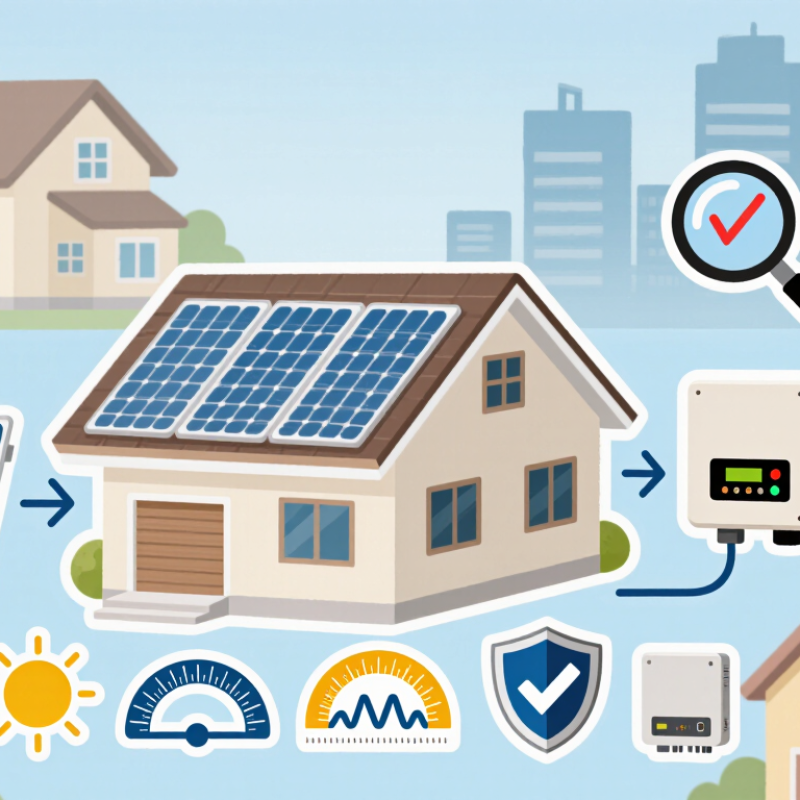
How to Choose the Best Grid On Inverter?

Understanding How Grid-Tied Inverters Work

A grid-tied inverter converts solar panels’ direct current into usable alternating current. It then synchronizes with the utility grid’s voltage, frequency, and phase. This coordination must be precise. Otherwise, the system may operate inefficiently or trigger protection settings.

When the grid is available, excess solar power can flow into the utility network, depending on local rules and the approved connection agreement. If the grid fails, a compliant inverter disconnects automatically through anti-islanding protection. This protects repair crews and nearby equipment. The best grid-tied inverter should match the array’s voltage range, expected power, and site temperature. Oversizing the panels slightly can improve annual production, but excessive oversizing may cause clipping. That trade-off deserves careful review.

Tips: Check the inverter’s maximum input voltage and MPPT operating range. Review its efficiency at partial loads, not only its peak rating. Ask for clear monitoring data, fault records, and installation documentation. Confirm that protective functions meet local electrical requirements. A qualified installer should also inspect cable length, ventilation, shading, and the service panel. Small details matter. I have seen theoretical designs underperform because afternoon shadows were ignored. Weather changes too, so production estimates should remain realistic rather than perfect.

Assessing Your Solar System’s Power and Grid Requirements

Choosing a grid-on inverter starts with measuring your solar system’s real power needs. Do not size it from panel wattage alone. A home with 6 kW of panels may have a different demand profile than a workshop with 4 kW. Record daytime loads, evening consumption, motor starts, and seasonal changes. Refrigerators, pumps, and air conditioners can create short but demanding surges. Peak load matters.

The inverter must also match the electrical grid. Check the supply voltage, phase arrangement, frequency, and permitted export capacity. Local utilities may require specific protection settings, remote shutdown functions, and anti-islanding performance. These controls prevent the inverter from feeding electricity into a failed grid line. A licensed electrician should confirm cable sizes, breaker ratings, earthing, and the connection point before installation. Paper specifications are not enough.

A practical assessment should compare the inverter’s continuous output with your actual daytime demand. Leave reasonable headroom for heat, dust, aging, and cloudy conditions. Oversizing the inverter may increase cost without improving production. Undersizing it can cause clipping during bright midday hours. A neat spreadsheet can still miss an old water pump or a new electric vehicle charger. That is where careful site observation helps. Measure twice. Revise the design when the evidence disagrees.

Comparing Inverter Types, Efficiency, and Key Features

How to Choose the Best Grid On Inverter?

A grid-on inverter converts solar electricity into usable AC power and synchronizes it with the utility grid. String inverters suit open, unshaded roofs with similar panel orientations. Microinverters work better when shade, multiple roof angles, or panel-level monitoring matters. Central inverters fit larger commercial systems, where service access and high power density can outweigh layout flexibility.

Efficiency deserves careful comparison. Peak efficiency often reaches 96% to 99%, but real output depends on temperature, low-light performance, wiring, and nighttime consumption. Use weighted efficiency rather than the highest headline figure. The IEA PVPS Trends 2024 report recorded more than 400 GW of new solar capacity in 2023, increasing demand for dependable conversion equipment. Small losses become significant at this scale.

Protection features also matter. Check anti-islanding compliance, surge protection, operating temperature, monitoring quality, and backup compatibility. IRENA’s Renewable Capacity Statistics 2024 reported 346 GW of solar additions in 2023, representing about 73% of new renewable capacity. Those figures show why grid stability cannot be treated as an afterthought. In field inspections, poor ventilation and loose connections repeatedly cause avoidable losses. I would not choose from efficiency alone. A quieter inverter may still have weaker monitoring, and a lower-cost unit may require more frequent service. The best choice depends on the roof, local grid rules, and the installer’s practical experience.

How to Choose the Best Grid On Inverter? - Comparing Inverter Types, Efficiency, and Key Features

Comparison Dimension String Inverter Microinverter Central Inverter Hybrid Grid-Interactive Inverter
Typical System Size Small to large residential and commercial systems, commonly from about 3 kW to 100 kW per inverter Residential and small commercial systems, generally one unit per solar module or two modules Large commercial and utility-scale installations, commonly from about 100 kW upward Residential and small commercial systems, commonly about 3 kW to 30 kW per inverter
Primary Operating Role Converts the combined DC output of a solar array into grid-compatible AC power Converts DC to AC at the module level before power is combined on the AC side Converts the DC output of a large solar field into high-power AC for grid connection Manages solar generation, grid power, battery charging, and selected backup loads
Typical Peak Efficiency Approximately 97%–99% Approximately 96%–99% Approximately 98%–99% Approximately 96%–99% in grid-connected operation
Energy Harvesting Good when modules have similar orientation, tilt, and sunlight exposure Very good where modules experience different shading, orientations, or tilt angles Very good for large, uniform solar fields with carefully designed string layouts Good to very good, depending on the solar MPPT design and battery operating mode
Impact of Partial Shading Shading on one module or string can reduce output from the affected string; module-level optimizers may help Usually limited to the shaded module or its connected circuit Can reduce production from a large portion of the array if affected strings share the same input path Depends on the number of MPPT inputs and array configuration; shading can affect connected strings
Maximum Power Point Tracking Usually one or more MPPT inputs; multiple trackers improve flexibility for different roof sections Module-level MPPT, providing independent tracking for each connected module Multiple high-voltage MPPT inputs designed for large groups of strings Usually one or more MPPT inputs, with additional controls for battery charging and discharging
Installation Complexity Moderate; DC strings, protection equipment, and an AC connection must be designed correctly Moderate; more rooftop electronics and AC cabling, but no high-voltage DC string wiring across the roof High; requires detailed electrical design, specialized equipment, and suitable grid infrastructure Moderate to high; requires coordinated solar, battery, backup-load, and grid connection design
Maintenance Access Generally easy because the inverter is usually installed in an accessible location Individual units are located beneath modules, which can increase access time for repairs Requires trained service personnel and planned maintenance procedures Usually accessible at the wall-mounted inverter, but batteries and backup equipment also require servicing
Scalability Good; additional string inverters or compatible inputs can be added within system limits Very good for phased residential expansion, provided electrical and communication limits are respected Good for large projects, but expansion requires careful protection, transformer, and grid studies Good for adding batteries or selected solar capacity, subject to inverter and battery compatibility
Battery Compatibility Usually requires a separate battery inverter or an AC-coupled storage system Often requires a separate battery system or an AC-coupled storage solution Normally paired with separate utility-scale battery power-conversion equipment Designed to integrate directly with compatible battery systems and energy-management controls
Backup Power During an Outage Normally unavailable during a grid outage unless paired with approved backup equipment and storage Normally unavailable during a grid outage unless integrated with a suitable backup system Requires specialized utility-scale controls and grid-forming equipment for islanded operation Can provide backup power when the model supports islanding, has a battery, and is installed with an approved transfer or backup circuit
Safety Characteristics May contain higher-voltage DC circuits between the array and inverter; rapid-shutdown requirements depend on local codes Reduces the length of high-voltage DC wiring on the roof because conversion occurs near the modules Uses high-voltage DC and high-power equipment; requires strict isolation, protection, and arc-fault practices Includes grid-isolation functions and battery safety controls; installation must follow applicable electrical and battery codes
Monitoring Capability Typically provides system-level monitoring; some systems also support string-level data Usually provides module-level monitoring and detailed fault identification Typically provides inverter, combiner, string, and plant-level monitoring Usually monitors solar production, household or facility demand, battery state of charge, and grid exchange
Typical Initial Cost Lower to moderate equipment cost per watt, especially for uniform roofs Moderate to high equipment cost because each module requires power electronics Cost-effective at large scale, but total project cost includes substantial electrical and civil infrastructure Moderate to high, with additional cost for battery integration and backup equipment
Best Fit Uniform roofs, open-field arrays, cost-sensitive projects, and systems with limited shading Complex roofs, multiple orientations, partial shading, and projects requiring module-level visibility Large, uniform solar plants where centralized operation and high power density are priorities Sites seeking solar self-consumption, time-of-use energy management, battery storage, or backup capability
Key Selection Checks MPPT voltage range, maximum DC voltage, DC-to-AC ratio, shading layout, grid voltage, and local protection rules Module compatibility, maximum module current and power, rooftop temperature rating, communications, and AC branch limits DC voltage class, transformer arrangement, medium-voltage connection, harmonic performance, cooling, and service plan Battery voltage range, usable battery capacity, backup output rating, transfer time, operating modes, and local certification
Important: Efficiency figures are representative industry ranges rather than guaranteed values. Actual energy yield depends on temperature, loading, shading, wiring losses, system design, grid conditions, and local installation requirements. Always verify the product datasheet and applicable electrical codes before selection.

Checking Safety Standards, Compatibility, and Installation Needs

How to Choose the Best Grid On Inverter?

Safety should lead the selection, not price. The IEA PVPS Trends 2024 report recorded more than 400 GW of new solar capacity in 2023. That scale increases the importance of reliable grid protection. Check compliance with IEC 62109-1 and IEC 62109-2 for inverter safety. Local certification may also require IEEE 1547-2018 or equivalent grid-interconnection rules. Confirm anti-islanding protection, overvoltage control, insulation monitoring, and fault detection. Ask for test certificates from an independent laboratory. Marketing claims are not enough.

Compatibility must match the actual array and site. Compare each string’s open-circuit voltage with the inverter’s maximum DC voltage. Leave extra voltage margin for cold mornings. Check MPPT voltage ranges, maximum input current, phase type, and utility voltage. The inverter should also support required frequency and reactive-power settings. Installation conditions matter. Measure roof temperature, cable distance, shading, ventilation, and enclosure exposure before ordering. A poorly ventilated inverter can derate during a hot afternoon. Use correctly rated breakers, isolators, surge protection, grounding, and weather-resistant connectors under local electrical rules. NFPA 70 provides widely used installation guidance in the United States, but regional requirements differ.

Field installers often discover small mismatches after delivery. A connector may fit physically but fail electrically. No checklist is perfect. Recheck the datasheets, utility approval, and commissioning procedure together. That extra hour can prevent a costly replacement.

Evaluating Costs, Warranty Coverage, and Long-Term Performance

When choosing a grid-on inverter, compare the total cost, not only the purchase price. A cheaper unit may require extra monitoring equipment, specialized installation, or costly replacement parts. Ask for a written estimate covering labor, wiring, permits, and future service visits. These details often change the real investment.

Warranty coverage deserves careful reading. Check whether it covers parts, labor, shipping, and on-site diagnosis. Some warranties begin on the purchase date, not the installation date. That difference matters when equipment remains in storage. Confirm the required installation conditions, maintenance records, and claim process. In my experience, unclear paperwork creates more frustration than hardware faults. Keep every invoice and commissioning report.

Long-term performance depends on heat management, conversion efficiency, and reliable monitoring. Review the expected efficiency range at different temperatures, not just the best laboratory figure. A shaded wall can protect equipment from harsh heat. Good ventilation still matters. Ask an experienced installer to assess local weather, grid conditions, and roof layout. Look for independent testing and certification from recognized electrical authorities. I once focused too heavily on efficiency and underestimated service access. That was a costly oversight. Consider performance degradation, firmware support, and replacement availability over ten years. A strong warranty is useful, but dependable local support may matter more. Check response times before signing.