

China’s welding equipment sector serves industries where consistent weld quality and safe workholding matter. Welding Positioners rotate or tilt workpieces into better welding angles, helping reduce awkward torch access and repeated repositioning. Their value is practical: a stable fixture, smooth rotation, and controls that operators can use confidently.
The International Federation of Robotics reported 541,302 industrial robot installations worldwide in 2023, with 276,288 installed in China. These figures describe robot installations, not welding-positioner sales. Still, they show the scale of China’s automation market and provide useful context for buyers comparing local manufacturers. The report is IFR’s World Robotics 2024.
Not all suppliers offer the same capabilities. This overview of ten Chinese manufacturers considers payload, table diameter, rotation and tilt ranges, drive systems, control options, documentation, and after-sales support. Specifications should be checked against the actual workpiece, welding process, and production cycle. Ask for drawings and load charts. Verify carefully. Published catalogs can leave out details that matter on a real shop floor, and a low price alone cannot establish reliability. No single public, independently audited ranking settles which companies are “top.” Treat this list as a starting point, then confirm current product data, references, and service coverage directly with each manufacturer.
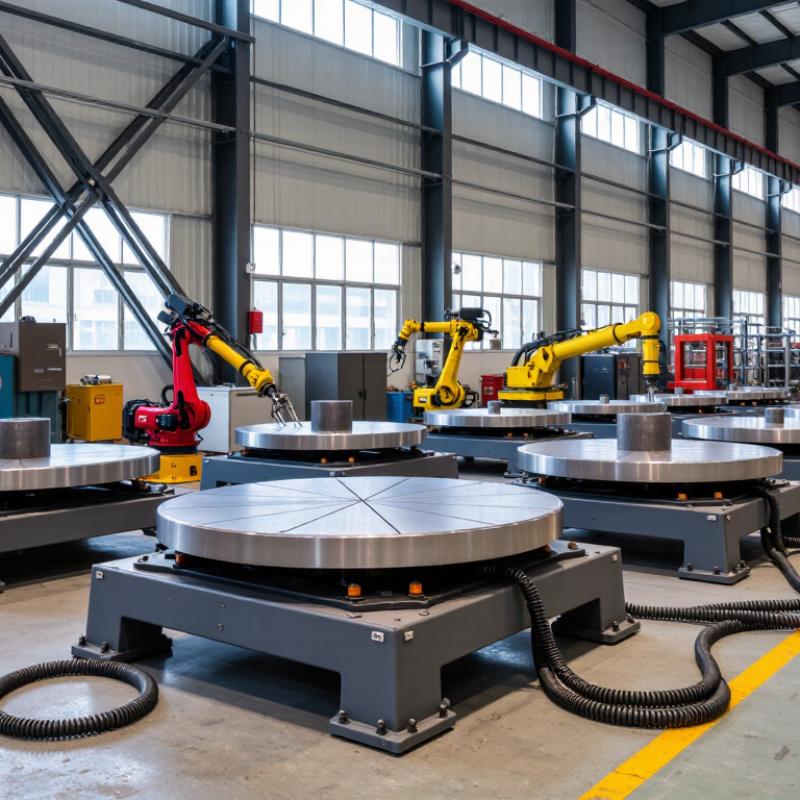
On a busy fabrication line, a welding positioner rotates and tilts the workpiece so the joint stays within easy reach. The welder spends less time repositioning heavy parts and more time maintaining a steady torch angle. That can reduce awkward reaches, repeated clamping, and avoidable pauses. Small gains compound. A fixture that turns smoothly also helps keep the weld pool visible, especially around pipe joints and bulky frames.
Positioners support repeatable work, but they do not guarantee better welds; setup, fit-up, and operator skill still matter. The International Federation of Robotics’ World Robotics 2024 report counted 4,281,585 industrial robots operating in factories worldwide at the end of 2023, up 10% year over year. This broader automation figure is not a welding-positioner productivity measure, but it shows why manufacturers are investing in consistent, controllable processes. In practice, teams can compare cycle times, rework, and operator handling before and after installation. Results vary with part size and production mix. A positioner may even slow a job if loading is poorly planned. That is worth checking.
Evaluating a Chinese welding positioner manufacturer means checking more than payload and price. Request a load chart covering both centered and off-center workpieces. Confirm rotation speed, tilt range, repeatability, and duty cycle against your actual weld schedule. Ask how the supplier calculates the combined weight of the fixture and workpiece. Numbers are not proof.
The International Federation of Robotics’ World Robotics 2024 report recorded 541,302 industrial robot installations worldwide in 2023, including 276,288 in China. These figures describe industrial robots, not welding positioners, but they show why integration capability matters. Ask for a live demonstration with a representative fixture, welding current, and cable routing. Watch for cable twisting, unstable stops, and vibration during slow rotation.
Request a factory acceptance test with your own load conditions, then record runout, repeatability, and motor temperature. Inspect welds on the frame, bearing access, electrical diagrams, and spare-parts lead times. Ask who handles commissioning and troubleshooting after delivery. A polished showroom demo can hide weak performance under sustained load. I would also verify each claim against test records; a missing document is not always failure, but it deserves a clear explanation.
Use the ten criteria below to compare manufacturers on verifiable product, engineering, quality, and service capabilities. Request evidence for the specific model and configuration being quoted.
| No. | Evaluation Dimension | What to Check | Evidence to Request | Practical Rating Signal |
|---|---|---|---|---|
| 1 | Rated Load and Workpiece Capacity | Confirm rated payload and whether the rating accounts for workpiece weight, fixtures, and any attached tooling. Check permitted center-of-gravity offset and load conditions. | Model-specific datasheet, load diagram, and written confirmation of the proposed workpiece and fixture configuration. | 0–5 points |
| 2 | Rotation and Tilting Performance | Compare rotation and tilt ranges, operating speeds, adjustment method, and whether both axes can move smoothly under the stated load. | Technical specifications, motion diagrams, and a demonstration or test record using a representative load. | 0–5 points |
| 3 | Positioning Accuracy and Repeatability | Ask how accuracy and repeatability are defined, measured, and affected by payload, speed, and operating conditions. Do not treat the terms as interchangeable. | Test method, recorded results, acceptance criteria, and the conditions under which measurements were taken. | 0–5 points |
| 4 | Drive, Braking, and Mechanical Design | Review drive sizing, braking or holding provisions, bearing arrangement, structural stiffness, and access for inspection and maintenance. | Assembly drawings, component specifications, maintenance instructions, and applicable load or functional test records. | 0–5 points |
| 5 | Controls and Integration | Check control functions, speed adjustment, operator interface, emergency-stop arrangements, and compatibility with the intended welding cell or automation system. | Electrical diagrams, control-function list, interface details, and confirmation of required signals and connection methods. | 0–5 points |
| 6 | Safety and Risk Documentation | Review safeguards for moving and rotating parts, electrical hazards, emergency stopping, and foreseeable misuse. Confirm that safety measures fit the installation and application. | Risk-assessment documentation and relevant design information. ISO 12100 and IEC 60204-1 may be useful references when assessing machinery safety and electrical equipment. | 0–5 points |
| 7 | Manufacturing and Quality Controls | Assess inspection procedures, traceability, calibration practices, nonconformance handling, and controls over outsourced components and processes. | Quality procedures, inspection records, calibration records, and any applicable quality-management or welding-quality certificates. | 0–5 points |
| 8 | Customization and Application Engineering | Determine whether the manufacturer can assess the actual workpiece geometry, fixture arrangement, duty cycle, and required welding access before selecting a model. | Completed application questionnaire, proposed layout or interface drawing, and a written technical review of the application. | 0–5 points |
| 9 | Testing, Delivery, and Documentation | Confirm what is tested before shipment, how acceptance is documented, and whether operating, installation, maintenance, and spare-parts information is supplied. | Factory acceptance-test plan, sample test report, packing list, manuals, and agreed delivery and acceptance requirements. | 0–5 points |
| 10 | Warranty, Service, and Spare Parts | Compare written warranty terms, technical support arrangements, spare-parts availability, and the process for handling faults and service requests. | Warranty document, service contact procedure, spare-parts list, and stated support coverage for the destination market. | 0–5 points |
Scoring guide: Rate each dimension from 0 to 5: 0 = no information supplied; 1 = limited or unsupported information; 2 = partial evidence; 3 = adequate documented evidence; 4 = strong, model-specific evidence; 5 = independently verifiable evidence and demonstrated performance. Compare suppliers using the same workpiece, fixture, duty cycle, and acceptance requirements. This framework is for evaluation and does not represent a verified manufacturer ranking.
A profile of ten Chinese welding positioner manufacturers should compare engineering focus, not rely on broad claims. One may specialize in compact tables for repair shops; another may build heavy-duty units for large weldments. A third might offer tilting fixtures, while a fourth focuses on rotating workpieces. Other profiles can cover custom configurations, standard production models, pipe-welding equipment, automated-cell integration, export-oriented service, and application-specific design. These are useful distinctions, not a ranking.
Look closely at the details behind each profile. Check rated load, table diameter, tilt angle, rotation speed, and drive type. Ask whether stated capacity applies during rotation or only at rest. That difference matters. A clear manufacturer profile should also explain controls, guarding, installation support, spare-part access, and how the equipment handles an actual workpiece. Request drawings or a trial plan when possible. Photos help, but they do not prove operating performance. Some product pages leave gaps; that is worth noting rather than guessing. Comparing ten suppliers this way gives buyers a more practical view of fit, service, and technical trade-offs.
The title identifies ten Chinese welding positioner manufacturers. This chart shows only that profile count; it does not compare or attribute product specifications to individual companies.
Welding positioners differ in how they support and orient a workpiece. A tilting table suits many compact assemblies, while head-and-tailstock designs can support long shafts or frames. Two-axis units combine rotation and tilt; more complex systems may add coordinated movement. More axes are not automatically better. They can add setup demands that a simple weld cell does not need.
Capacity needs careful comparison. Check the rated load, but also confirm whether it applies when the table is tilted. A heavy part mounted far from the center creates more leverage than the same load placed centrally. Look at allowable eccentric load, table diameter, rotation speed, and the height of your fixtures. A specification sheet rarely shows every awkward setup. That matters.
Automation ranges from pendant-controlled rotation to programmable motion and integration with welding equipment. For repeat jobs, saved speed and angle settings can reduce repositioning and help keep the torch path consistent. For varied, short-run work, straightforward controls may be easier to operate. Ask manufacturers to demonstrate a representative part, including loading and clamping—not just an empty table turning. A perfect demo is unlikely, and that is useful: real fixtures reveal clearance problems early. Select the machine around actual part dimensions, weld access, and daily cycle time, then verify those details before purchase.
For buyers comparing Chinese welding-positioner manufacturers, start with the workpiece, not the catalogue. Record its maximum weight, dimensions, centre of gravity, and required rotation range. Ask suppliers to size the unit for the combined load of the part and fixture. A high payload rating alone can mislead. Eccentric loads may demand more torque and affect safe, smooth rotation.
Check how the manufacturer verifies performance. Request load-test records, electrical drawings, maintenance guidance, and details of available controls. The International Federation of Robotics’ World Robotics 2024 report records 541,302 industrial robots installed worldwide in 2023, reflecting the scale of industrial automation. That trend makes control-system compatibility worth checking, even for a standalone positioner. Confirm signal interfaces, rotation speed, repeatability, and whether the unit can coordinate with your welding process.
Look closely at the welds and finish on the sample machine. Ask how bearings, cables, and drive components are protected from heat, sparks, and dust. Request a live demonstration using a load similar to yours, then observe stopping accuracy and movement under rotation. One detail is easy to miss. Compare warranty terms, spare-part availability, and response times in writing. A lower quote may exclude installation or training. I would still leave room for uncertainty: published specifications do not prove the machine will suit every fixture or production cycle.