2026 Best Fiber Optic Cable Types for Global Buyers?
Choosing the right fiber optic cable in 2026 requires more than comparing price, speed, and product length. Global buyers must examine installation conditions, transmission distance, bandwidth needs, connector quality, and regional compliance requirements. A cable designed for a protected data center may fail in a coastal trench, rooftop cabinet, or crowded industrial site.
Charles K. Kao, widely recognized as the father of modern fiber-optic communications, said, “The potential of optical fiber is enormous.” His insight remains relevant as networks support cloud computing, 5G, artificial intelligence, smart factories, and high-capacity international links. Yet potential alone does not guarantee performance. Selection details matter.
This guide examines the best fiber optic cable types for global buyers in 2026. It compares single-mode and multimode designs, indoor and outdoor constructions, armored and non-armored options, and common cable categories such as G.652D, G.657A, OM3, OM4, and OM5. It also considers practical issues, including bend radius, water resistance, pulling tension, fire ratings, connector compatibility, and factory testing.
Real projects are rarely perfect. Specifications can be unclear. Installation teams may overlook temperature changes or mechanical stress. Some buyers also choose premium cable without confirming actual network requirements. That approach wastes budget.
Reliable purchasing depends on verified data, experienced suppliers, recognized standards, and honest field evaluation. The strongest choice is not always the newest cable. It is the cable that matches the route, equipment, environment, and long-term maintenance plan.
What Is Fiber Optic Cable and How Does It Transmit Data?
Fiber optic cable carries data as pulses of light through thin strands of glass or plastic. Each strand has a core, cladding, and protective coating. The core guides light, while cladding keeps it inside through total internal reflection. In practical installations, this structure supports stable links across offices, data centers, factories, and long-distance networks. It is not simply “a faster wire.” That description is convenient, but incomplete.
A transmitter converts electrical signals into rapid light pulses using a light source. A receiver detects those pulses and changes them back into electrical data. Digital patterns represent images, voice, files, and control commands. Single-mode fiber usually sends light through a narrow core for long distances. Multimode fiber uses a wider core and often suits shorter building links. The right choice depends on distance, bandwidth, equipment, and installation conditions.
Cable performance also depends on connector cleanliness, bend radius, splice quality, and pulling tension. A cable can meet excellent specifications and still fail after rough handling. A common field lesson is that small installation errors can create intermittent links that resemble equipment faults. Testing with optical power meters and reflectometers reveals signal loss, reflections, and damaged sections. Global buyers should verify construction, temperature ratings, fire requirements, and test documentation before ordering. Specifications alone are not enough. Field conditions matter more than many product sheets admit.
Which Fiber Optic Cable Types Are Available for Global Buyers?
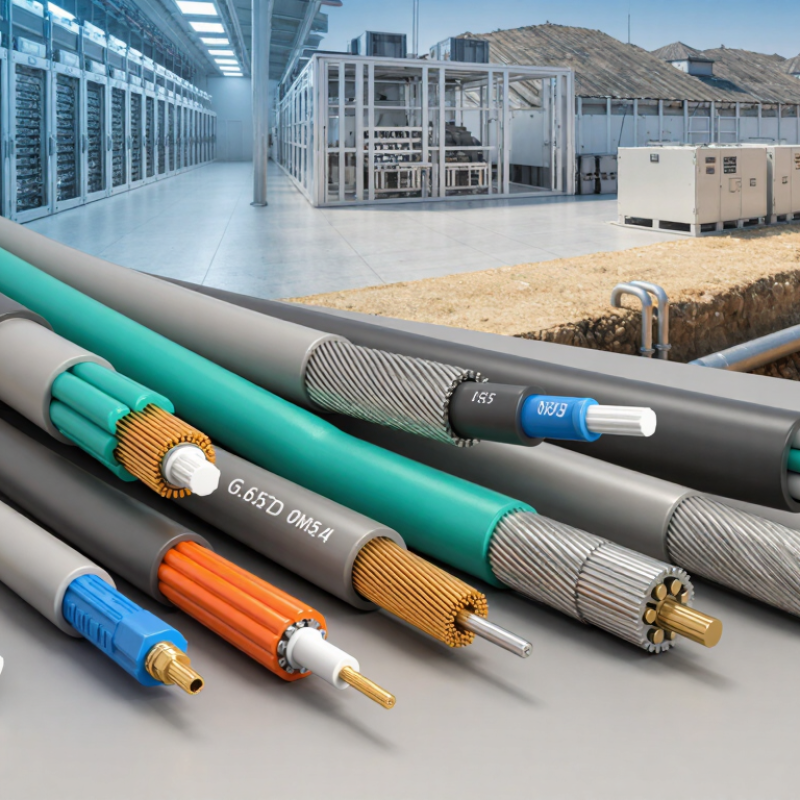
Global buyers can choose from several fiber optic cable types, depending on distance, installation space, and environmental risk. Single-mode fiber supports long-distance links between cities, data centers, and telecom sites. Multimode fiber suits shorter connections inside buildings and campus networks. Common grades include OS2 for single-mode systems and OM3, OM4, or OM5 for multimode applications. Simplex cable carries one fiber path, while duplex cable carries two paths for two-way communication.
The cable structure matters as much as the fiber itself. Tight-buffered cable is practical for indoor patching and short vertical runs. Loose-tube cable protects fibers from moisture and temperature changes outdoors. Armored cable adds resistance against crushing, rodents, and accidental impact. Buyers may also select aerial, duct, or direct-burial designs based on the route. Ribbon cable can improve fiber density in large installations, but it may require specialized splicing equipment.
Specifications can mislead.
Check the jacket rating, bend radius, connector type, attenuation, and operating temperature before ordering. In my experience, many failures start with a simple mismatch between indoor cable and outdoor conditions. A lower-cost cable may also increase installation labor later. Local standards, testing reports, and traceable quality records deserve careful review. Yet no single cable type fits every project; route surveys and realistic maintenance plans should guide the final choice.
How Do Single-Mode and Multimode Cables Compare?
Global network demand keeps rising. The ITU’s Facts and Figures 2023 estimated 5.4 billion people were online worldwide. That growth makes fiber selection a practical cost decision, not merely a technical preference.
Single-mode fiber uses a narrow light path and typically operates at 1310 or 1550 nanometers. Its attenuation can approach 0.22 dB per kilometer at 1550 nanometers. This supports metropolitan links, data-center interconnects, and submarine routes extending many kilometers. It also leaves more room for future upgrades. However, transceivers and installation can cost more, especially in short indoor links.
Multimode fiber carries several light paths through a larger core. It suits building backbones and short data-center connections. Under ISO/IEC cabling guidance, OM3 and OM4 support 100-gigabit links at roughly 100 and 150 meters, respectively, with suitable optics. It is easier to deploy in compact spaces. Still, distance limits arrive quickly.
The Cisco Annual Internet Report forecast 29.3 billion connected devices by 2023. That forecast is dated, but the pressure it identified remains visible in crowded server rooms. In real projects, multimode can be economical for short runs, while single-mode offers stronger expansion potential. The boundary is not tidy. A low-cost choice today may create expensive migration work later.ablytyped
What Standards and Purchasing Factors Should Global Buyers Check?
2026 Best Fiber Optic Cable Types for Global Buyers?
Global buyers should check standards before comparing price. ITU’s Facts and Figures 2024 estimates that 5.5 billion people used the internet, creating sustained demand for reliable optical infrastructure. For single-mode networks, verify ITU-T G.652.D for standard backbone links and G.657.A1 or G.657.A2 when tight bends are expected. These specifications matter in crowded cabinets and narrow building pathways.
Multimode buyers should match OM3, OM4, or OM5 cable with the required transmission distance and equipment. ISO/IEC 11801 and TIA-568.3-D help define performance, polarity, testing, and installation practices.
Check IEC 60793 for fiber characteristics and IEC 60794 for cable construction. A low-smoke, zero-halogen jacket may suit indoor public spaces, while armored or water-blocked designs can protect outdoor routes.
Always confirm connector loss, return loss, tensile strength, crush resistance, operating temperature, and flame rating.
Do not trust a promising datasheet alone. Ask for factory test results, sample inspection records, and traceable batch identification. I would also request insertion-loss testing at the actual operating wavelengths, not only a general pass certificate. Cisco’s Annual Internet Report projected 29.3 billion connected devices by 2023, showing why small losses can become costly at scale. The difficult part is choosing enough margin without buying unnecessary specifications. That decision deserves a site survey.