
Choosing the best Carbon fiber production line supplier in China requires more than comparing equipment prices. A serious evaluation should examine the complete process, from precursor feeding and stabilization to carbonization, surface treatment, sizing, drying, and winding. Each stage affects tensile strength, modulus, consistency, energy use, and production stability.
Dr. Suresh G. Advani, a respected composites processing researcher, has stated, “Manufacturing quality must be designed into the process, not inspected in afterward.” This principle fits carbon fiber production closely. A supplier should provide measurable process controls, not only attractive brochures. Ask for temperature uniformity data, line-speed records, tension-control performance, and sample testing procedures. Visit an operating factory when possible. Watch the fiber move through the furnace. Small tension changes can become costly defects.
The strongest supplier may offer pilot validation, process training, spare parts, and responsive engineering support. A low quotation can hide weak commissioning assistance or limited automation. That matters.
No single supplier is perfect.
Even experienced buyers can trust spreadsheets too quickly. Production goals, precursor type, fiber grade, factory conditions, and local energy costs must be checked together. A reliable Carbon fiber production line supplier should explain technical limitations honestly. It should also help customers improve the line after installation. This introduction explores how to compare Chinese suppliers through process capability, equipment reliability, quality evidence, customization, service, and long-term operating value. Performance should be proven, not promised.
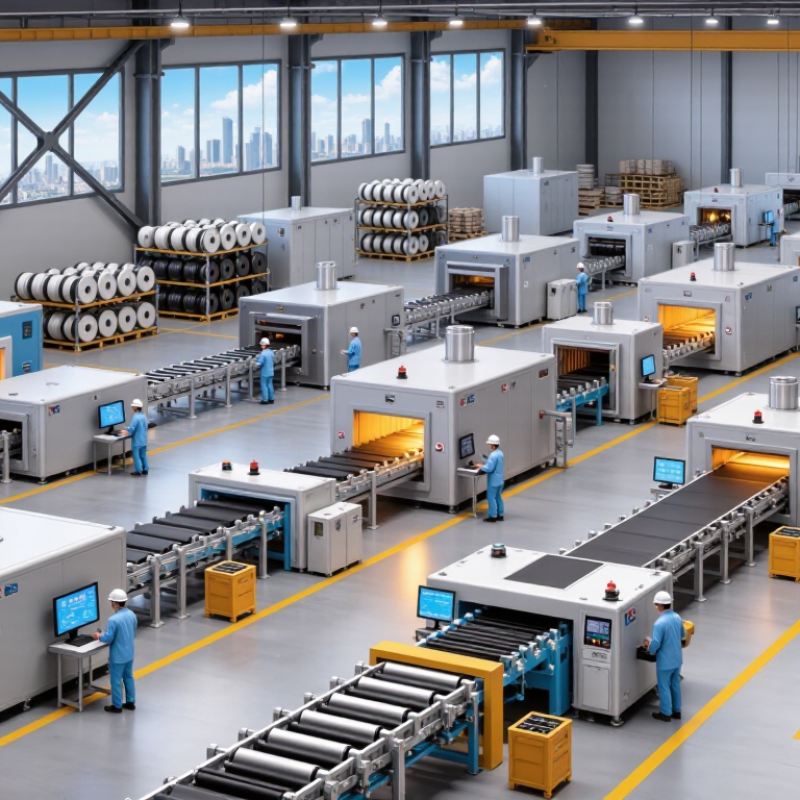
A carbon fiber production line converts precursor fiber into strong, lightweight carbon fiber through controlled thermal and chemical processes.
A typical line includes precursor feeding, oxidation ovens, carbonization furnaces, surface treatment units, sizing equipment, drying systems, and winding machines. Each component affects tensile strength, modulus, consistency, and production speed.
The core functions are stabilization, carbonization, surface activation, and final packaging.
Oxidation prepares the fiber for high-temperature treatment. Carbonization removes non-carbon elements in a controlled atmosphere. Surface treatment improves bonding with resin, while sizing protects the fiber during handling.
In practical commissioning, temperature uniformity and tension control often decide product quality. Small deviations can create uneven color, broken filaments, or unstable strength. A perfect line rarely exists. Careful adjustment remains necessary.
Tips:
Ask potential Chinese suppliers for process data, factory acceptance records, maintenance plans, and sample testing results. Check whether the control system records temperature, tension, gas flow, and alarm history. Request a pilot trial before full-scale production. Details matter. Also review operator training, spare-part availability, exhaust treatment, and safety documentation. A low purchase price may hide costly upgrades later. Evaluate lifecycle performance, not only the initial quotation.
Carbon fiber production begins with precursor selection, usually PAN, because molecular structure controls the final tensile strength. The U.S. Department of Energy’s carbon fiber assessments indicate that precursor materials can represent nearly half of total production cost. That figure makes quality consistency more important than a low purchase price. Small variations in polymer composition can later become large defects.
The main process includes spinning, stabilization, carbonization, surface treatment, and sizing. During stabilization, PAN fibers are heated in air, often between 200°C and 300°C. Carbonization then uses inert gas at temperatures commonly above 1,000°C. Higher-temperature treatment can improve modulus, but it also increases energy demand. The International Energy Agency reported that industrial heat remains a major source of manufacturing emissions, so furnace efficiency deserves serious inspection. Not just output.
In practical supplier audits, engineers should check line speed, furnace temperature uniformity, tension control, and waste rates. A clean fiber may still fail if sizing adhesion is inconsistent. Surface treatment must improve bonding without damaging the filament. According to technical reviews from the National Renewable Energy Laboratory, process integration can reduce cost and improve material utilization, but results vary by precursor and equipment design. Claims need evidence. Request batch records, tensile-test data, and maintenance histories. I would also question unusually high yield figures; real production includes broken filaments, filter changes, and trial runs. A reliable Chinese production line should show stable data across several lots, not only a perfect sample.
| Process Stage | Primary Material or Input | Typical Equipment | Key Operating Conditions | Main Quality-Control Parameters | Resulting Intermediate or Product |
|---|---|---|---|---|---|
| 1. Precursor Preparation | Polyacrylonitrile (PAN) polymer, solvent, comonomers, and processing additives | Polymerization reactors, blending tanks, filtration units, and storage systems | Controlled polymer concentration, molecular weight, solution viscosity, and temperature; conditions vary by precursor formulation | Polymer composition, molecular-weight distribution, viscosity, impurity level, and solution homogeneity | Stable PAN spinning solution or precursor feedstock |
| 2. Fiber Spinning | PAN spinning solution or melt-processable precursor | Metering pumps, spinnerets, coagulation baths, washing units, and godet rollers | Wet spinning is commonly used for PAN; draw ratio, bath composition, extrusion rate, and drying conditions must be closely controlled | Filament diameter, linear density, tensile uniformity, surface defects, and residual solvent | Continuous PAN precursor tow |
| 3. Washing and Drying | Freshly spun PAN precursor containing residual solvent and moisture | Counter-current washing lines, squeeze rollers, dryers, and tension-control systems | Multiple washing stages remove residual solvent; drying temperature and line tension are adjusted to limit filament sticking and deformation | Residual solvent, moisture content, tow spread, filament breakage, and dimensional stability | Clean, dry, and dimensionally stable PAN precursor |
| 4. Stretching and Annealing | Washed PAN precursor tow | Hot stretching ovens, heated rollers, tension-control units, and tow guides | Controlled drawing aligns polymer chains; the exact temperature and draw ratio depend on precursor chemistry and target properties | Molecular orientation, crystallinity, tow tension, filament roundness, and tensile strength | Highly oriented PAN precursor suitable for stabilization |
| 5. Oxidative Stabilization | Oriented PAN precursor tow | Multi-zone stabilization ovens, air-circulation systems, exhaust treatment, and tension-control equipment | Usually performed in air at approximately 200–300 °C; residence time and tension are controlled to promote cyclization and oxidation | Color change, stabilization degree, density, exotherm control, mass loss, and tow integrity | Thermally stabilized ladder-structure fiber |
| 6. Carbonization | Stabilized PAN fiber | Inert-atmosphere carbonization furnaces, nitrogen supply, seals, rollers, and off-gas systems | Typically conducted under nitrogen or another inert atmosphere at approximately 1,000–1,500 °C; oxygen ingress must be minimized | Carbon content, mass loss, density, tensile strength, modulus, filament breaks, and furnace atmosphere | Carbon fiber with the required strength and modulus range |
| 7. High-Temperature Treatment | Carbonized fiber requiring higher modulus or improved graphitic ordering | High-temperature furnaces, inert-gas systems, tension-control units, and cooling sections | Optional treatment commonly above 1,500 °C and potentially above 2,000 °C, depending on the target grade | Modulus, crystallite orientation, density, electrical conductivity, surface condition, and strength retention | High-modulus or specially tailored carbon fiber |
| 8. Surface Treatment | Carbon fiber requiring improved resin adhesion | Electrochemical treatment cells, washing tanks, drying ovens, and chemical-dosing systems | A controlled aqueous or electrochemical treatment introduces functional groups without excessively damaging the fiber surface | Surface oxygen content, interfacial shear strength, tensile-strength retention, coating uniformity, and bath concentration | Activated carbon fiber surface compatible with a selected resin system |
| 9. Sizing Application | Surface-treated carbon fiber and compatible sizing formulation | Sizing applicators, metering systems, drying ovens, and winding equipment | Sizing add-on is commonly controlled at a low percentage of fiber mass; formulation and level depend on the intended resin matrix | Sizing content, coating uniformity, moisture, fuzz level, spreadability, and resin compatibility | Protected carbon fiber tow ready for conversion or shipment |
| 10. Winding, Packaging, and Inspection | Finished carbon fiber tow | Precision winders, tension monitors, weighing systems, inspection stations, and moisture-resistant packaging | Controlled winding tension and package geometry prevent tow damage, slippage, and downstream processing problems | Tow count, package weight, winding density, tensile properties, modulus, defects, and traceability records | Finished carbon fiber packages for prepreg, filament winding, weaving, pultrusion, or other applications |
Note: Operating ranges are representative industrial values. Exact settings depend on precursor chemistry, tow size, furnace design, target tensile properties, modulus requirements, resin compatibility, and applicable quality standards.
Best Carbon Fiber Production Line Supplier in China?
How to Evaluate Carbon Fiber Production Line Suppliers in China
Evaluating a carbon fiber production line supplier requires more than comparing quotations. Check experience with oxidation, carbonization, surface treatment, and winding equipment. Ask for production data from similar lines. Reliable suppliers should explain temperature uniformity, tension control, energy use, and expected fiber quality. A factory visit can reveal practical details, such as clean assembly areas, calibrated instruments, and organized spare-part storage. Ask engineers how they handle broken tow or unstable furnace temperatures. Their answers often show real expertise.
Tips: Request sample testing, process drawings, equipment lists, and clear acceptance standards. Verify whether commissioning support includes operator training and production troubleshooting. Speak with previous customers, but do not rely only on selected references. Independent inspection can strengthen confidence. It may add cost.
A dependable supplier should provide traceable quality records, realistic delivery schedules, and documented after-sales responsibilities. Review the contract carefully. Terms for installation, warranties, software access, and replacement parts should be specific. A low quotation may exclude utilities, tooling, or training. That mistake can become expensive later. No supplier is perfect, and overly polished presentations deserve careful questions. Evaluate both technical capability and communication during difficult discussions. Consistent, honest answers matter more than impressive promises.
Choosing a carbon fiber production line requires more than comparing machine prices. A reliable supplier should show documented process control, material traceability, and repeatable test results. ISO 9001 certification is useful, but certificates alone cannot prove stable production. Ask for records from pilot runs, including tow tension, furnace temperature, line speed, and tensile strength. Testing should follow recognized methods, such as ISO 10618:2017 for carbon fiber tensile properties.
Market pressure makes consistency increasingly important. The Global Wind Energy Council reported 117 GW of new wind capacity installed worldwide in 2023. Carbon fiber supports lightweight structures in this expanding sector, but every application has different performance demands. A suitable Chinese production line may need customized oxidation ovens, carbonization furnaces, surface treatment units, or sizing systems. Technical support should include installation supervision, operator training, recipe development, remote diagnostics, and spare-parts planning. Response time matters during a furnace fault.
Tips: Request a sample production plan before signing. Check temperature uniformity across each furnace zone. Require a clear acceptance test with measurable limits. Visit an operating facility if possible. A video call is helpful, but it cannot reveal every maintenance problem.
One practical lesson is uncomfortable: faster production can create more waste. No trial is truly final. Suppliers should review failed batches honestly and adjust the process. Choose evidence over confident promises. Reliable support is visible in data, troubleshooting records, and patient technical communication.
A supplier’s quotation should separate the line price from tooling, shipping, commissioning, training, and spare parts. Grand View Research valued the global carbon fiber market at about USD 3.9 billion in 2023. Its report projects strong growth through 2030, increasing pressure on capacity and delivery schedules. Request a costed bill of materials, not a single attractive number. Check the price of ovens, tension controls, winding units, exhaust systems, and replacement heating elements. Hidden exclusions are common.
Delivery needs measurable milestones. Ask for design approval, factory acceptance testing, packing, port departure, arrival, installation, and site acceptance dates. A practical contract should define delay responsibility and provide weekly progress evidence. Use video records and serial-number lists before shipment. Installation also depends on your factory. Confirm power loads, cooling water, compressed air, ventilation, floor loading, and local safety requirements. The supplier should send experienced engineers, provide bilingual manuals, and train operators on tension, temperature, and line speed settings. Three days of training may be insufficient for a complex line.
Supplier verification requires more than a polished factory tour. Request audited financial information, quality certificates, process flowcharts, calibration records, and references from comparable projects. The ISO Survey reports millions of certified management systems worldwide, but certification alone does not prove process capability. Ask for carbon-fiber test data, including tensile strength, sizing content, tow uniformity, and break frequency. Witness a live production trial if possible. Some promised output figures remain optimistic. Insist on acceptance criteria, sample testing, warranty scope, and spare-part availability before signing.