What is Anti Drone Device and How Does It Work?
In an increasingly unmanned world, the Anti Drone Device has emerged as a critical technology. Experts stress its importance in security and privacy protection. For instance, Dr. Emily Carter, a leading specialist in drone defense systems, notes, "The Anti Drone Device is essential for safeguarding our airspace."
These devices detect, track, and neutralize unauthorized drones. They work using advanced sensors and jamming technologies. With the rise of drone incidents, their implementation has become more urgent. Various industries, from airports to military bases, are exploring these protective measures.
However, the technology is not without challenges. Concerns about interference with legitimate drones and regulatory compliance remain. Continuous improvement and thoughtful design are necessary for the future of the Anti Drone Device. As we advance, balancing safety and innovation will be crucial. This field prompts ongoing reflection and dialogue among professionals.
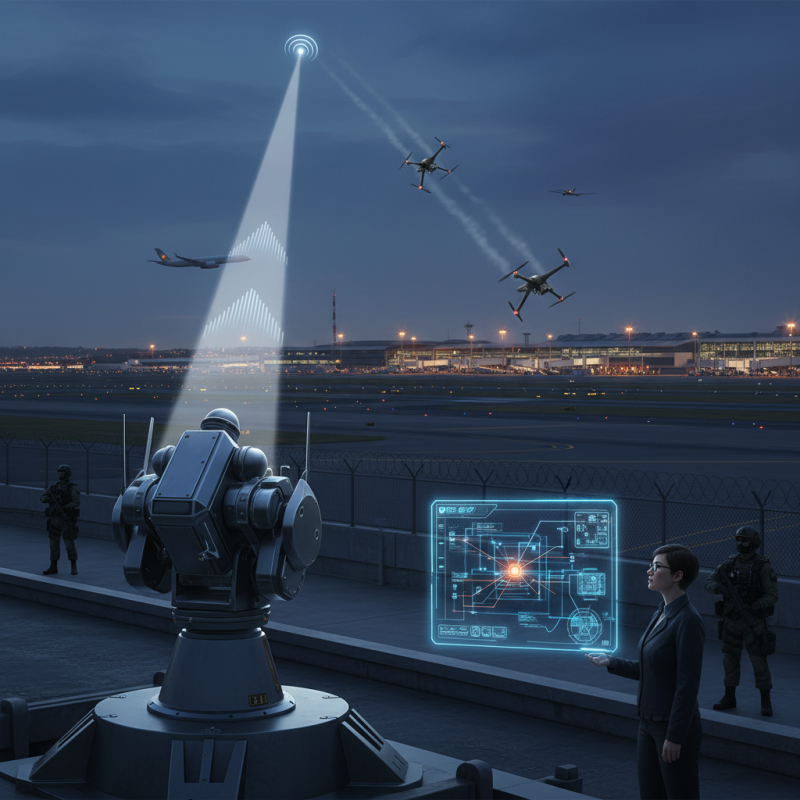
What is an Anti Drone Device? An Overview of Its Purpose and Functionality
Anti-drone devices are specialized technologies designed to detect and neutralize unmanned aerial vehicles (UAVs). Their main purpose is to protect sensitive areas, such as airports, military bases, and large public events, from potential threats posed by rogue drones. These devices utilize various sensors, including radio frequency detectors and radar systems, to identify drones in their vicinity.
Once a drone is detected, an anti-drone device can employ several methods to neutralize it. For example, some systems jam the communication signals between the drone and its operator, causing the drone to lose control. Others may be equipped with net guns or directed energy weapons to physically capture or disable the intruding drone. Such functionalities highlight the importance of these devices in ensuring safety and security.
Despite their capabilities, the effectiveness of anti-drone devices can vary widely. Factors like environmental conditions and the technology used by the drones can influence outcomes. Additionally, ethical and legal concerns arise when implementing these systems. Balancing security needs with privacy rights can be challenging. Continuous improvements and discussions around the responsible use of anti-drone technology are crucial as this field evolves.
Types of Anti Drone Technologies: Jamming, Net Capture, and More
Anti-drone technology has become increasingly important in various sectors. Different methods exist to counter unauthorized drones. These methods can safeguard sensitive areas like airports, military sites, and major events.
Jamming is a widely used technique. It disrupts the communication between a drone and its operator. The technology uses radio frequency interference. This can cause the drone to lose control, forcing it to land or return to its starting point. However, jamming has its limitations. It may unintentionally disrupt other devices operating on similar frequencies. This unintentional interference can pose challenges.
Net capture systems are another approach. These devices use physical nets to capture drones, effectively neutralizing them. They can be deployed from the ground or launched from another drone. This method avoids the risks associated with jamming. However, it requires precise targeting and may struggle with larger drones or those flying at high altitudes. This highlights the need for continuous improvement in anti-drone technologies and their effectiveness.
Key Components of Anti Drone Systems: Sensors, Detectors, and Interceptors
Anti-drone systems rely on key components: sensors, detectors, and interceptors. These elements work together to identify and neutralize unauthorized drones. Recent industry reports indicate that the global anti-drone market is projected to reach $3.3 billion by 2027, driven by increasing security concerns.
Sensors are crucial for monitoring airspace. They typically use radar, radio frequency (RF) technologies, or visual systems to detect drone activity. For instance, a sophisticated radar can track small flying objects up to several kilometers away. Detecting a drone involves analyzing its communication patterns. This is where advanced RF detection systems come into play. They can identify drone signals and determine if they are benign or a threat.
Interceptors come into action once a drone is detected. These may include electronic jamming devices that disrupt a drone’s control signals. Some systems deploy net-based solutions to physically capture drones. The effectiveness of these interceptors can sometimes be inconsistent, raising questions about their reliability in real-world scenarios. Simplistic designs may overlook the nuances of drone technology. Adapting to rapidly evolving drone capabilities remains a critical challenge for security providers.
Industry Applications of Anti Drone Devices: Security, Military, and Public Safety
The use of anti-drone devices has surged in various sectors, including security, military, and public safety. According to a recent report by MarketsandMarkets, the global anti-drone market is expected to reach $2.4 billion by 2025, growing at a compound annual growth rate (CAGR) of 23% during the forecast period. This rapid growth highlights the increasing demand for protection against unauthorized drone activities, which pose risks to sensitive areas and events.
In the security industry, anti-drone systems are deployed at major events to ensure safety. High-profile gatherings, such as sports events and political rallies, require robust measures to mitigate risks from drones. The need for effective countermeasures is evident, as reports indicate that more than 1,200 incidents involving drones were recorded near airports last year. These incidents can disrupt flight operations and endanger lives. Public safety officials are now more aware of the potential threats and are actively seeking reliable solutions.
The military applications of anti-drone devices are equally critical. Unmanned aerial vehicles can be used for reconnaissance or direct attacks. A report from the Pentagon noted a sharp rise in drone-related incidents on battlefields. Hence, counter-drone technologies have become a fundamental part of military strategy. However, these systems can sometimes malfunction or be ineffective against certain types of drones. Continuous improvements are necessary for operational reliability. This balancing act between innovation and security measures remains an ongoing challenge in modern defense.
Market Trends and Forecast: Growth of the Global Anti Drone Technology Sector
The anti-drone technology sector is witnessing significant growth. According to a recent market report, the global anti-drone market is projected to reach $3.2 billion by 2025, expanding at a CAGR of over 23% from 2020. This surge is driven by increasing concerns about security threats posed by unauthorized drones. Various sectors, including military, law enforcement, and commercial industries, are extensively investing in anti-drone solutions.
Emerging trends influence the adoption of these technologies. Governments prioritize public safety, resulting in increased funding for counter-drone systems. Moreover, technological advancements in sensors and jammers enhance detection capabilities. Drones can now be neutralized with precision, reducing false positives. However, challenges remain, such as managing software interoperability among device systems.
Tip: Always keep yourself updated on market trends. Understanding technological advancements will help inform decisions in procurement. Seek reports focusing on regional growth patterns, as local threats vary. Additionally, consider the diversity of applications when evaluating anti-drone solutions. This sector is evolving rapidly, but not all devices meet operational needs effectively. Carefully assess each piece of technology for your requirements.